
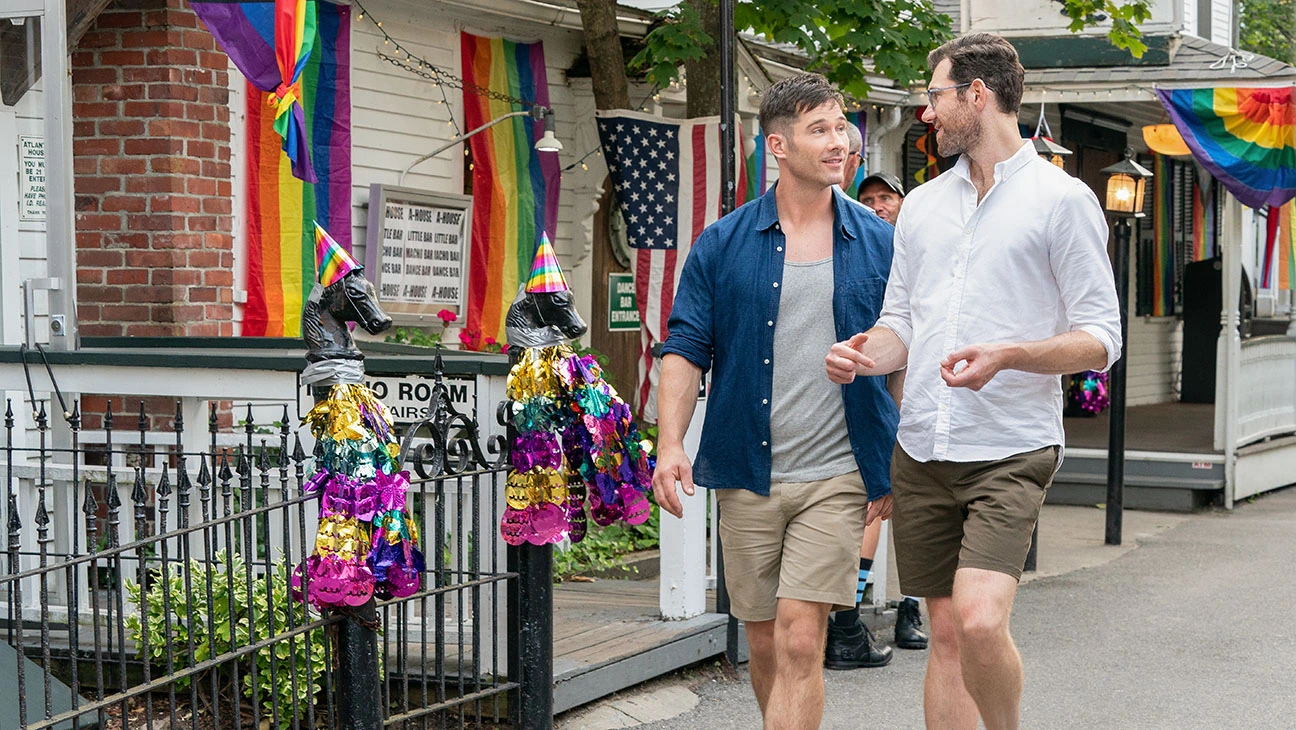
 Courtesy Of: Universal Studios
By Carter Vickers
Hollywood has been trying to facilitate more LGBTQ+ representation in its films. Although it’s clear that most of the film industry still prioritizes heteronormative stories, any slice of representation is nice, despite each shortcoming bringing about worry for the future of much-needed stories due to financial instability. Recently, the film Bros directed by Nicholas Stoller (Forgetting Sarah Marshall) became a box office failure despite high hopes for being the first successful gay rom-com. After the lead actor blamed straight people for the film’s flop, it prompts the question: what is the reasoning behind this letdown, and what does the underwhelming attendance mean for the future of LGBTQ+ representation in film and media? Despite earning generally positive reviews and an 88% on Rotten Tomatoes, the film earned a measly $4.8 million while being produced on a $22 million budget (not to mention the $30 million marketing budget).
After a disappointing opening weekend, the film’s producer and lead actor Billy Eichner (“Billy on the Street”) expressed his grievances on Twitter: “That’s just the world we live in, unfortunately. Even with glowing reviews, great Rotten Tomatoes scores, an A CinemaScore, etc, straight people, especially in certain parts of the country, just didn’t show up for Bros. And that’s disappointing but it is what it is” (Eichner, October 2022). His statement generated backlash against his judgment of movie-goers and assumption of homophobia. Although the assumption is easy to come by, this is not necessarily the full case. LGBTQ-themed movies such as Rocketman and Brokeback Mountain performed incredibly well throughout the country. I believe the main issue is simple: people don’t go out to see many non-high-budget action films anymore. We see this with movies such as Spider-Man: No Way Home making $1.9 billion in theaters, compared to a movie such as Nightmare Alley making $37 million in theaters. So unless you are a member of a ticket subscription service (like AMC A-List), it’s hard to reason against waiting for the movie to come to streaming, where I am sure it will be a huge hit (and on planes, of course).
Aside from people not going out and seeing Bros in movie theaters, the film could have benefitted by a stronger marketing strategy. Universal marketed the movie more toward the mainstream as “the first-ever gay comedy,” shutting off wider audiences because they felt like they wouldn’t be able to relate to its content. Many gay people did not know about its release or were even turned off by it, with one Twitter user saying “The jokes are there but they’re every gay cliche in the book, just without ever being clever or funny” and another adding “Bros could be the best movie ever but the name alone is a turnoff sorry not sorry.” If it were advertised as a comedy that happens to have gay characters, not as a gay film that happens to be a comedy, it could have appealed to a wider audience. Many also did not see the movie due to the way Eichner reacted to opening weekend, with some claiming, “You target a movie to a small percentage of the population, criticize half the country, and then wonder why no one wants to see your movie. I rarely go to movies anymore. They’re garbage. Why would I go see this?” and “Homophobia is certainly a reason why many people aren’t seeing it, but it’s so far down the list of reasons why this movie is a flop”.
It’s still disappointing, considering exactly how poorly the film performed, and it makes cause for worry when it comes to executives greenlighting future LGBTQ+ films. However, it’s a relief when rethinking why this movie underperformed in the box office and considering other LGBTQ+ films that didn’t. The case of this film shouldn’t determine the outcome of any future queer films, advertisements, plays, etc, as there is an extremely high need for this film genre with a huge pre-existing audience. The concept of Bros was a step in the right direction; we need those mindless gay stories just as much as straight ones. As a young gay male entering the film industry, I hope to tell my own stories someday–maybe even righting the wrongs of movies like this.