

By Bonnie Moss, President and Founder, Moss Networks
In a saturated content environment–consider that 2.7 million companies post each day on LinkedIn alone–it can be challenging to make sure your content stands out with your audience. On top of that, tightening budgets put increased pressure on comms teams to maximize ROI and prove value.
How can you be sure that your business is focusing its PR and marketing efforts for the best results? One effective method is to follow the holistic approach known as the PESO Model™—a comprehensive visual guide to amplifying all elements of your marketing and PR campaigns for stronger overall results.
What is the PESO Model?
The PESO Model was created by Gini Dietrich of Spin Sucks as a framework to describe and measure PR and marketing efforts and results across four key media categories.
- Paid: social ads, search ads, boosted content, sponsored content, lead generation, paid publishing, and other purchased media placements.
- Earned: media that arises from relationships with media professionals, bloggers, investors, and influencers, as well as word-of-mouth and SEO/link-building.
- Shared: media that is created and/or shared by social media users, reviewers, and forum participants.
- Owned: media that your business creates–everything from your website and blog posts to webinars, case studies, podcasts, and videos.
The goal of the PESO Model is to help communications professionals understand what works and what doesn’t, so you can calculate ROI and allocate your resources most effectively. Leveraging the PESO model for this kind of holistic approach can ensure that all your media types are in balance and working together to drive your business goals.
Why use the PESO model for PR and marketing?
The PESO Model can help you plan your media outreach and content creation efforts, so you can avoid relying too heavily on just a few types of media, such as paid or owned. That’s important because each PESO component has weaknesses as well as strengths.
Paid media is easy to launch, scale up, and adapt as your messaging evolves. However, most B2B purchasing decision makers are skeptical of ads, and they have to be personalized correctly to avoid backfiring. For example, TrustRadius found that 25% of B2B technology buyers are less likely to buy from a vendor that shows them irrelevant ads.
Earned media can be very persuasive, because it arises from people’s genuine interest in or enthusiasm for a company’s products or services, rather than from paid sources. However, the direct impact of earned media to sales metrics can be challenging to measure accurately, so it’s often underrepresented in marketing efforts.
Shared media, which relies on customer and fan enthusiasm, can also strongly influence your audience. 54% of B2B technology buyers consult user reviews before they make a purchasing decision, according to TrustRadius data. Only product demos were sought out more during the research phase. It’s hard to control the nature, volume, and reach of shared media, however, which means it can require intensive cultivation to deliver results.
Owned media is yours forever. It’s content that your business creates, so you can control the messaging, tone, and timing. However, for your owned media investment to pay off over the long term, you’ll need to leverage it through paid, earned, and shared channels–and this is another area where the PESO Model is useful–not only for ensuring balance in your efforts but also for combining strategies to maximize amplification.
This graphic shows how PESO categories can “overlap” and work together holistically for the best possible results.
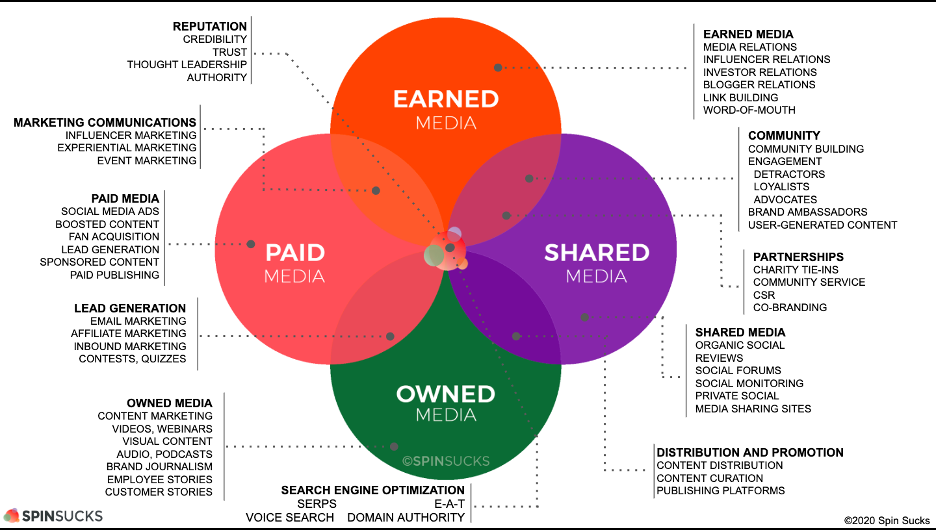
This is a dense model with many potential combinations, but it doesn’t have to be overwhelming. Instead, view it as a guide to spark ideas for leveraging your own company’s content through different channels, and think about how your PR and marketing efforts can intersect for greater impact. For example, you might take a paid thought leadership byline and turn it into a blog post that lives on your website (with a canonical link), then develop a social carousel illustrating key points in the post, and then use the carousel elements in an infographic that is marketed and used by the sales teams.
Each time you leverage and extend your content through new formats and channels, and then use those iterations in your PR efforts, you’re amplifying your message and your impact. At the heart of this diagram sits the archetype in any PR, marketing, or comms campaign – credibility, trust, authority. These are the elements that an experienced PR team can work with to build productive relationships with media outlets, social communities, customers, partners, employees, and other stakeholders.
Optimize the PESO Model for your business
Seeing all the options the PESO Model provides can be exciting and overwhelming at first. Rather than try to implement everything right away, we recommend a step-by-step adoption strategy that helps you plan, test, and capitalize on your PESO efforts.
Get creative to expand on your existing efforts. For example, if you’re already distributing press releases and working with the media to secure interviews, consider adding thought leadership articles and podcast appearances or speaking opportunities at industry events for more visibility and authority. If your social content right now is text-and-graphics posts, switching it up with short videos and interactive polls can increase your shared media reach.
Track your new programs as they go live. Following KPIs for paid ads, social posts, and content on your site is relatively easy. Attributing earned media can be more challenging, but it is possible. When you’re working with media outlets that are publishing your thought leadership articles, you can link to other relevant, non-promotional content on your site–such as data-based reports that give your claims a source within the article–so you can track the source of traffic from the article (and earn authority clout with Google).
Fine-tune your new projects. Seeing how your new programs perform can help you improve individual campaigns and your overall PESO strategy. It can also show you which content performs best among specific audiences and in specific channels, so you can identify the areas where it makes sense to niche down your topics and formats. You can use your data to identify more potential PESO initiatives, such as turning customer stories into social video shorts for shared media and ads for paid media if videos perform well with your audience.
How Moss Networks gets powerful results with the PESO Model
We love the PESO Model because it illustrates the holistic approach to brand recognition that we’ve taken for more than 20 years. Our strategies have always seen the value of combined efforts–from media buys and convention speaking engagements to awards, podcasts, video testimonials, original research and traditional media and analyst relations (just to name a few). That’s because effective branding isn’t just about one of those services, it’s about the way all of them work together.
For example, with one e-commerce technology client, we designed regular consumer surveys and created reports based on the data for our client’s audience of ecommerce businesses. To promote those reports and expand their reach, we wrote blog posts and created infographics highlighting key trends and different findings from the report (such generational differences in buying habits, regional payment preferences, and more).
Then we promoted the blog posts and infographics through email and social ad campaigns, and pitched the key ideas from the blog posts to journalists who cover generational differences, e-commerce trends, and other relevant topics. When earned coverage was secured from those pitches, we promoted it through social and email campaigns. This experience shows how one piece of owned media–the survey report–can extend into paid, earned, and shared media to amplify the impact and value of the report and maximize exposure.
In our experience, PR and marketing strategies that use the PESO model holistically see the best ROI for their efforts and the biggest impact on brand recognition, trust, and authority. If you’d like to learn more about how we can apply the PESO Model to help grow your brand, contact us. We’d love to talk with you.